
Lighting Guides & Tips
How Many Lumens Per Square Foot (Room-by-Room Guide)
When planning your lighting setup, one of the most common questions is: “How many lumens per square foot do I need?”. Understanding this number is key to achieving the right brightness in every room – not too dim, not too harsh.
Lumens measure how much visible light a bulb produces. Unlike watts, which only indicate energy consumption, lumens tell you how bright the light actually is. The higher the lumens, the brighter the light output.
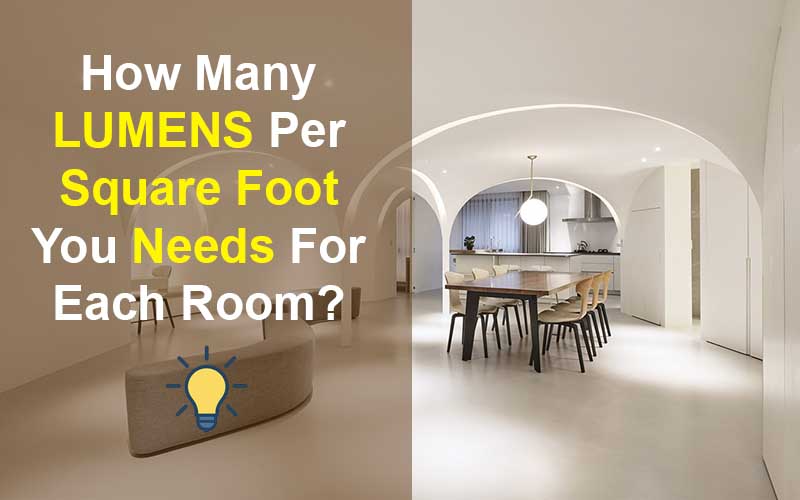
When you spread that brightness across a certain area, you get lumens per square foot, also known as foot-candles. This measurement helps you figure out if your space is properly illuminated for its intended purpose – whether it’s a cozy living room, a bright kitchen, or a well-lit workshop.
For example:
- A living room typically needs around 10–20 lumens per square foot for comfortable ambient lighting.
- An office or workshop may require 50–100 lumens per square foot to ensure clear visibility and reduce eye strain.
In short, knowing how many lumens you need per square foot helps you create the perfect lighting balance – enhancing both comfort and functionality while saving energy.
Understanding Lumens, Foot-Candles, and LED Brightness
Before calculating how much light your space needs, it’s important to understand the basic lighting units: lumens, foot-candles, and lux.


Rattan Pendant Light

Rattan Pendant Light

Rattan Pendant Light

Rattan Pendant Light

Rattan Pendant Light
1. Lumens (lm)
A lumen measures the total amount of light emitted by a bulb. For example, a standard 10-watt LED bulb produces about 800 lumens, which is roughly equivalent to a 60-watt incandescent bulb.
When comparing bulbs, always look at lumens, not watts – since modern LED lights produce much more lumens per watt than older bulbs.
This concept is often referred to as LED lumens per square foot, meaning how efficiently LED bulbs deliver light over a given area.
2. Foot-Candles (fc)
A foot-candle measures the intensity of light falling on a surface – literally, one lumen spread over one square foot.
In other words:
1 foot-candle = 1 lumen per square foot.
So, when someone asks “how many foot-candles per square foot”, it’s the same as asking how bright a surface is under that amount of illumination.
Professional lighting designers often use foot-candles to determine lighting levels for workspaces, studios, or commercial areas.
3. Lux
If you’ve seen lighting specs using lux, that’s simply the metric version of foot-candles.
1 foot-candle = 10.76 lux.
Lux measures how many lumens fall on one square meter instead of one square foot. While lux is more common in Europe, foot-candles remain the standard in the U.S.
4. Why These Units Matter
Knowing these units helps you translate bulb specifications into real-world brightness. For instance:
- A bright kitchen countertop might need 50–80 lumens per square foot (around 50 foot-candles).
- A relaxing bedroom might only require 10–20 lumens per square foot.
- A garage or workshop could need 70–100 lumens per square foot for safety and precision tasks.
By understanding how many LED lumens per square foot your space requires, you can confidently select fixtures that meet both your visual comfort and energy-efficiency goals.
| Unit | What It Measures | Conversion / Relation | Typical Use or Example |
|---|---|---|---|
| Lumens (lm) | Total amount of light emitted by a bulb | — | A 10W LED ≈ 800 lumens (≈ 60W incandescent) |
| Foot-Candles (fc) | Light intensity falling on a surface | 1 fc = 1 lumen / sq. ft | Used by lighting designers to gauge brightness |
| Lux (lx) | Metric version of light intensity | 1 fc = 10.76 lux | Common in Europe and international standards |
How to Calculate Lumens Per Square Foot
Once you understand what lumens mean, the next step is learning how to calculate lumens per square foot for your own space.
This simple calculation helps you determine how many lumens you need per square foot to achieve ideal brightness.
1. The Basic Formula
The formula is straightforward:
Lumens per square foot = Total lumens ÷ Room area (in square feet)
Step 1: Measure your room.
Multiply the room’s length × width to find the total square footage.
Step 2: Add up the total lumens from all light sources in that space.
For example, if you have three 800-lumen LED bulbs:
3 × 800 = 2,400 lumens total.
Step 3: Divide the total lumens by the room’s area.
Example:
Room size = 150 sq ft
Total lumens = 2,400
2,400 ÷ 150 = 16 lumens per square foot
That means your room receives roughly 16 foot-candles, which is a comfortable level for a living room or hallway.
2. What If You Don’t Know the Lumens?
If you only know the wattage, here’s a quick guide for LED bulbs:
| LED Wattage | Approx. Lumens |
|---|---|
| 5W | 450 lumens |
| 9W | 800 lumens |
| 12W | 1100 lumens |
| 15W | 1600 lumens |
| 20W | 2000 lumens |
Because LEDs are highly efficient, how many LED lumens per square foot you need will always be much lower in wattage compared to traditional bulbs.
So, instead of thinking “how many lights per square foot,” focus on total lumens – the true measure of brightness.
3. Using Online Calculators
If math isn’t your thing, you can use an online lighting lumens calculator.
Simply enter your room’s size, purpose, and the number of fixtures – the tool will tell you how many lumens of light per square foot are recommended.
This is especially useful for large or irregularly shaped rooms like kitchens, garages, or workshops.
Recommended Lumens Per Square Foot by Room Type
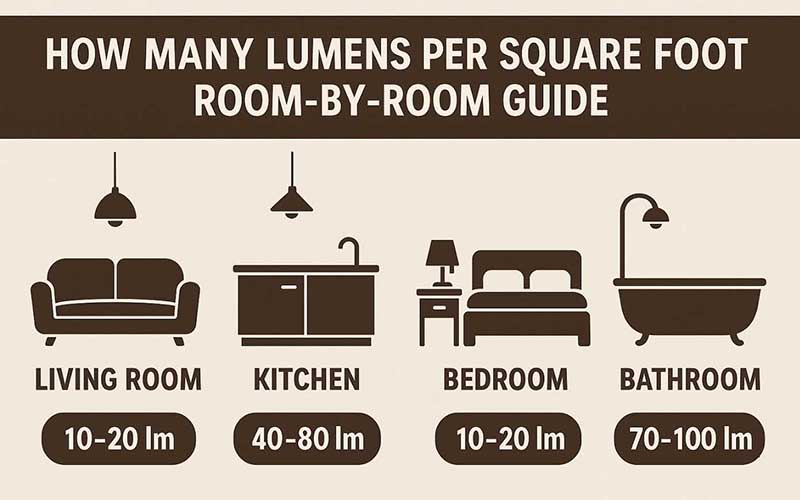
Not all spaces require the same amount of light. A home office, for instance, needs far more brightness than a bedroom or living room. Below is a practical chart to help you determine how many lumens per room or per square foot you should aim for.
1. How many lumens per square foot for a Living room
Remember Living room is a relaxing space.
You don’t want harsh lighting, 10-20 lumens per square foot is perfect for creating a warm, cozy atmosphere.
Layer your lighting with a mix of ceiling lamps, rattan pendant lights, and soft wall sconces to add depth.
2. How many lumens per square foot Office spaces
In focus-intensive areas, the recommended lighting level for office spaces is generally higher, ranging from 50 to 75 lumens per square foot.
This level ensures you can read, write, or work on a computer comfortably without eye strain.
Combine overhead LED panels with task lamps for optimal balance.
3. How many lumens per square foot Kitchen
Cooking areas demand precision, so 50–80 lumens per square foot is ideal.
Use recessed lighting or pendant fixtures directly over countertops and islands where you need clarity.
If you’re using warm-tone LED bulbs, make sure they still provide sufficient brightness.
4. How many lumens per square foot Garage or Workshop
Many people underestimate how many lumens per square foot a garage or workshop requires.
Since these spaces involve detail work – tools, repairs, crafts – aim for 70–100 lumens per square foot.
LED shop lights are the best choice here because they deliver high brightness with minimal energy use.
So whether you’re wondering how many lumens per square foot in a shop or how many lumens per square foot for a workshop, the answer usually falls within that same range.
5. Bathroom and Vanity Areas
Bathrooms benefit from bright, clear light – usually 70–100 lumens per square foot, especially near mirrors.
This helps achieve accurate color reflection and precision for makeup or shaving.
6. Bedrooms and Hallways
Lower levels of 10–20 lumens per square foot create a calm, restful atmosphere.
Warm lighting helps maintain a soothing environment for winding down at night.
Lighting Recommendation Chart
| Room / Area | Recommended Lumens per sq ft (Foot-candles) | Lighting Purpose |
|---|---|---|
| Living Room | 10–20 | Comfortable ambient lighting |
| Dining Room | 30–40 | Balanced light for meals and gatherings |
| Kitchen | 50–80 | Task lighting for food prep areas |
| Bedroom | 10–20 | Relaxed, cozy illumination |
| Bathroom | 70–100 | Bright lighting for grooming |
| Office / Study | 50–75 | Focused, clear lighting for reading and screens |
| Garage / Workshop | 70–100 | Strong, shadow-free visibility |
| Hallway / Entryway | 5–15 | Subtle guiding light |
| Outdoor Patio | 10–20 | Soft evening glow |
By following this guide, you’ll know exactly how many lumens per square foot each room in your home or workspace needs – ensuring every corner is beautifully and efficiently lit.
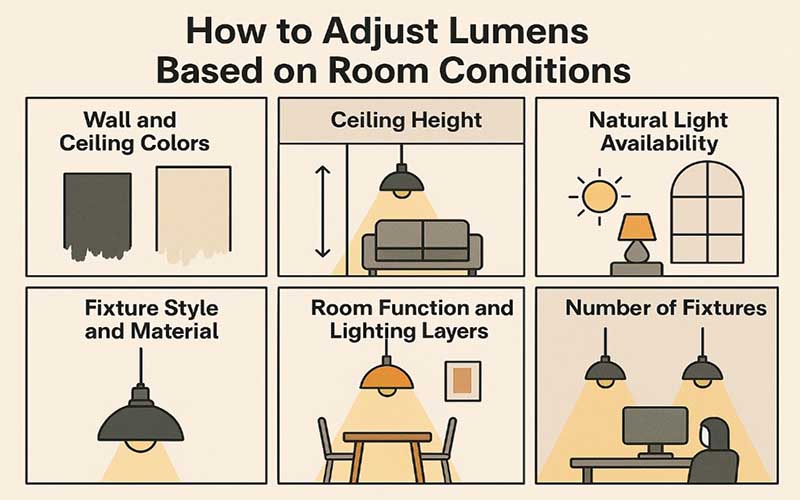
How to Adjust Lumens Based on Room Conditions
Even after calculating the right lumens per square foot, your space might still feel too bright or too dim.
That’s because several real-world factors affect how much light you actually perceive.
Here’s how to fine-tune your lighting and understand how many lights per square foot or how many lumens of light per square foot you truly need in your situation.
1. Wall and Ceiling Colors
Light bounces off surfaces – so the color of your walls and ceiling matters a lot.
- Light-colored walls reflect more light, meaning you can use fewer lumens to achieve the same brightness.
- Dark-colored walls or wood paneling absorb light, so you’ll need 10–20% more lumens per square foot to compensate.
For example, a cozy living room with dark furniture might need 20 lumens per square foot, while a minimalist white room feels bright at just 12 lumens/sq ft.
2. Ceiling Height
High ceilings can make a room feel spacious but also absorb more light.
If your ceiling is above 9 feet, increase your lumen output by 25–30%.
This ensures that light reaches the functional areas instead of getting lost above eye level.
3. Natural Light Availability
A room with large windows or skylights needs fewer lumens during the day.
However, if you rely mostly on artificial light (like in a garage, basement, or workshop), it’s safer to stick with higher lumen levels – around 70–100 lumens per square foot.
4. Fixture Style and Material
The type of fixture can either amplify or soften brightness:
- Clear glass or open fixtures distribute light widely.
- Fabric lampshade or woven shades (like rattan or bamboo pendant lights) diffuse light softly, perfect for ambiance but less ideal for task lighting.
In that case, add an extra 10–15% lumens or another light source to balance brightness.
5. Room Function and Lighting Layers
A well-designed space uses layered lighting – ambient, task, and accent.
For example:
- Ambient: ceiling lights or chandeliers provide overall brightness.
- Task: desk lamps or under-cabinet lights for focused work.
- Accent: wall sconces or spotlights to highlight décor.
By combining these layers, you can easily reach your desired lumens per square foot without overlighting the room.
6. Number of Fixtures
If you’re wondering how many lights per square foot you need, the answer depends on the lumen output of each fixture.
Let’s say you want 50 lumens/sq ft for a 200 sq ft office – that’s 10,000 lumens total.
If each LED light gives 1,000 lumens, you’ll need about 10 lights evenly distributed across the ceiling.
Pro Tip:
Always choose dimmable LED fixtures. They allow you to fine-tune brightness based on time of day or activity – perfect for balancing energy efficiency and comfort.
Real-Life Examples: How Many Lumens Per Room You Really Need
Now let’s apply everything we’ve learned with a few real-world examples.
These calculations show how many lumens needed per square foot and the total lumens per room you’ll want for the best lighting performance.
1. Example 1: Bedroom
- Room size: 120 sq ft
- Recommended brightness: 15 lumens/sq ft
- Calculation: 120 × 15 = 1,800 lumens total
Use two bedside table lamps (each 600 lumens) and one ceiling fixture (around 600 lumens).
That gives you soft, balanced light perfect for reading and relaxation.
2. Example 2: Living Room
- Room size: 200 sq ft
- Recommended brightness: 15–20 lumens/sq ft
- Total: 200 × 18 = 3,600 lumens
A mix of ceiling fixtures and a few accent lamps works best.
For example, one 1,500-lumen pendant light combined with two 900-lumen floor lamps easily hits this range.
This setup keeps the room cozy but bright enough for social gatherings or TV watching.
3. Example 3: Kitchen
- Room size: 150 sq ft
- Recommended: 70 lumens/sq ft (task lighting included)
- Total: 150 × 70 = 10,500 lumens total
That may sound like a lot, but remember the kitchen requires strong, shadow-free light.
Combine recessed LED ceiling lights with pendant lights above the island to achieve even brightness.
4. Example 4: Home Office
- Room size: 120 sq ft
- Recommended: 60 lumens/sq ft
- Total: 120 × 60 = 7,200 lumens total
Use a bright overhead LED panel (around 4,000 lumens) and a desk lamp (1,500–2,000 lumens).
This ensures enough lumens per square foot for reading, typing, and video calls without eye strain.
5. Example 5: Garage or Workshop
- Room size: 180 sq ft
- Recommended: 80–100 lumens/sq ft
- Total: 180 × 90 = 16,200 lumens total
Work areas need powerful illumination.
LED strip lights or linear fixtures deliver high brightness efficiently.
If you’re wondering how many lumens per square foot for a workshop or garage, this range guarantees safe, clear visibility for every task.
6. Example 6: Dining Room
- Room size: 100 sq ft
- Recommended: 30–40 lumens/sq ft
- Total: 100 × 35 = 3,500 lumens total
Hang a central chandelier or woven pendant light over the table for ambiance, and use wall sconces for subtle accent lighting.
7. Example 7: Bathroom
- Room size: 80 sq ft
- Recommended: 80 lumens/sq ft
- Total: 80 × 80 = 6,400 lumens total
Install bright, clear vanity lights near mirrors and waterproof LED ceiling lights for even coverage.
Key Takeaway
As you can see, the ideal lumens per square foot changes depending on room size and function.
Once you know your total lumen goal, it’s easy to decide how many lights per square foot you’ll need – or whether a single bright LED fixture can do the job.
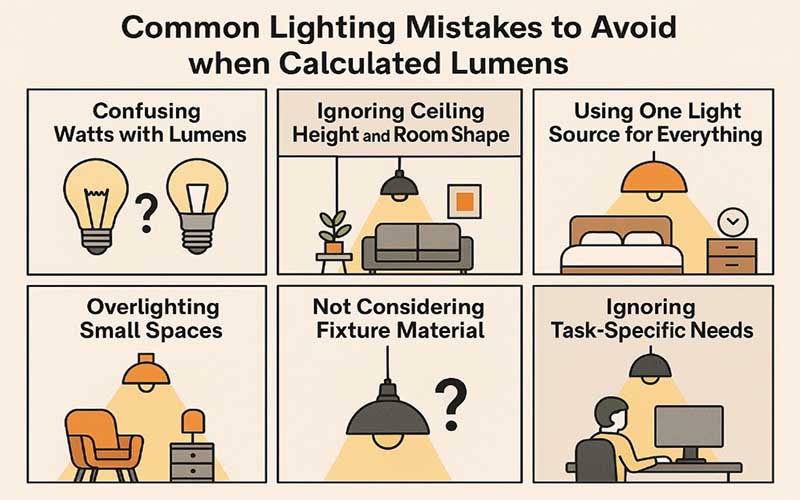
Common Lighting Mistakes to Avoid
Even if you’ve calculated your lumens per square foot correctly, a few common mistakes can still throw off your lighting plan. Here’s what to watch for:
1. Confusing Watts with Lumens
This is the most frequent mistake.
Watts measure energy consumption – not brightness. A 10-watt LED bulb can produce the same brightness as a 60-watt incandescent bulb.
So when you’re determining how many lumens needed per square foot, always look at the lumen output listed on the packaging, not the wattage.
2. Ignoring Ceiling Height and Room Shape
Light behaves differently in a tall or irregularly shaped space.
If your room has a vaulted ceiling or open layout, you’ll need to increase lumens by 20–30% for even illumination.
Skipping this step often leads to dim corners or uneven brightness.
3. Using One Light Source for Everything
Relying on a single fixture to light an entire room is one of the biggest errors.
Even if you meet the technical lumen requirement, the light will feel flat or uncomfortable.
Instead, mix ambient, task, and accent lighting – this layered approach makes a room both functional and visually appealing.
4. Overlighting Small Spaces
More light isn’t always better. Overlighting wastes energy and can make a space feel harsh or clinical.
For example, a small bedroom only needs around 1,500–2,000 total lumens, not 5,000.
Use dimmers or smart bulbs to adjust brightness to your liking.
5. Not Considering Fixture Material
Different materials affect how light spreads:
- Glass or metal shades project more direct brightness.
- Wicker, fabric, or rattan shades soften and diffuse light.
If you use diffused fixtures, you may need to increase your LED lumens per square foot slightly to maintain overall illumination.
6. Ignoring Task-Specific Needs
Each room serves a different purpose.
A garage or workshop needs much stronger lighting than a living room or bedroom.
If you’re unsure how many lumens per square foot for a workshop or garage is enough, aim for 80–100 lumens/sq ft for safety and clarity.
By avoiding these mistakes, you’ll achieve balanced, comfortable, and efficient lighting – perfectly suited to your lifestyle and home design.
Frequently Asked Questions (FAQs)
Below are some of the most common questions people ask when designing their lighting.
Each one answers a specific search intent, helping clarify how many lumens per square foot are ideal for various spaces.
A foot-candle is equal to one lumen per square foot.
For most residential spaces, you’ll need between 10 and 30 foot-candles depending on the room type.
Workspaces or workshops often require 50–100 foot-candles for precise tasks.
In general:
Living areas: 10–20 lumens/sq ft
Kitchens and offices: 50–75 lumens/sq ft
Workshops and garages: 70–100 lumens/sq ft
LED lights are highly efficient, so even a few bulbs can meet these targets easily.
Workshops, garages, and craft areas need strong illumination.
You should aim for 80–100 lumens per square foot to ensure clear visibility and safety.
For example, a 200 sq ft garage may need 16,000–20,000 lumens total, distributed across multiple LED fixtures.
Shops and retail environments need balanced brightness to highlight products without glare.
The ideal range is 50–80 lumens/sq ft, depending on whether it’s a display area or a checkout counter.
Spotlights and LED track lights can help direct focus where it matters most.
For offices or study areas, aim for 50–75 lumens per square foot.
That level keeps text clear and reduces eye strain, especially during long hours at the computer.
If your office has darker walls, add 10–15% more lumens for even brightness.
Living rooms work best with softer, ambient lighting – around 10–20 lumens per square foot.
Layer your setup with floor lamps, ceiling fixtures, and accent lighting for a cozy yet functional feel.
Kitchens and dining rooms need 40–80 lumens/sq ft, with brighter lighting directly over work surfaces and dining tables.
Pendant lights or under-cabinet LEDs are great for achieving this.
There’s no single rule, since each fixture has a different lumen output.
As a general guideline:
1,000 lumens covers about 20 square feet for most indoor spaces.
So if you want 50 lumens/sq ft in a 200 sq ft office, you’ll need roughly 10 fixtures at 1,000 lumens each.
This depends on the room’s purpose and size:
Small bedroom (100 sq ft): ~2,000 lumens
Living room (200 sq ft): ~3,600 lumens
Kitchen (150 sq ft): ~10,000 lumens
Workshop (180 sq ft): ~16,000 lumens
The key is to adjust lumens per square foot to match the room’s tasks and mood.
Lumens: total light output.
Watts: energy consumption.
Foot-candles: light intensity on a surface (equal to lumens per square foot).
For energy-efficient lighting, focus on lumens per square foot, not watts.
Commercial spaces like offices, shops, and showrooms typically require 50–100 lumens per square foot, depending on ceiling height and room color.
Brighter spaces improve visibility and enhance product appeal.
Yes – but do so carefully.
Warm lights (2700K–3000K) are best for relaxation areas, while neutral white (4000K–4500K) fits offices and kitchens.
The lumen level determines brightness, while color temperature affects mood.
Conclusion: Find the Perfect Brightness for Every Space
Choosing the right lighting isn’t just about picking pretty fixtures – it’s about creating balance.
By understanding how many lumens per square foot your space truly needs, you can design a home that feels both functional and inviting.
Use the chart and examples in this guide to find your ideal brightness:
- Living areas: 10–20 lumens per sq ft
- Workspaces & offices: 50–75 lumens per sq ft
- Garages, shops & workshops: 70–100 lumens per sq ft
When you calculate how many lumens do I need per square foot, remember that every room has its own story.
A cozy living room deserves a warm, diffused glow; a workshop thrives under crisp, bright light.
Don’t forget to adjust for wall color, ceiling height, and fixture style – small tweaks can make a huge difference in comfort and energy efficiency.
If you’re unsure, start with dimmable LED fixtures or smart bulbs. They let you fine-tune brightness levels until your lighting feels “just right.”
In the end, knowing your lumens per square foot means more than numbers – it means crafting an atmosphere that supports how you live, work, and relax every day.
Read More
- How Many Watts Per Square Foot for LED Lighting
- Lighting Temperature Guide: Warm vs Cool White Explained
👉Looking for lighting that’s both functional and beautiful?
Explore our handcrafted pendant and ceiling lights at VietShopDesign.com – designed with perfect brightness and timeless craftsmanship.

Read more articles
25+ Bedroom Floor Lamp Ideas to Brighten & Elevate Your Space
Bedroom floor lamp ideas offer one of the simplest and most stylish ways to elevate [...]
Oct
Best Laundry Room Lighting Ideas for a Brighter, Cleaner Space
Laundry Room Lighting Ideas focus on turning one of the hardest-working spaces in your home [...]
Sep
20+ Guest Bedroom Lighting Ideas for a Warm, Welcoming Space
Guest bedroom lighting ideas focus on creating a warm, welcoming, and comfortable environment for anyone [...]
Sep
Best Study Room Lighting Ideas for a Bright and Focused Space
A well-designed study room is more than just a desk and a chair – it’s [...]
Sep
20+ Master Bedroom Lighting Ideas for a Modern, Elegant Space
Master bedroom lighting ideas go far beyond simply choosing a ceiling fixture. A master bedroom [...]
Sep
10 Home Office Lighting Ideas for a Bright, Productive Workspace
The home office has become one of the most important rooms in modern living. Whether [...]
Aug
How to Fix Eye Strain from Bad Home Office Lighting
You take screen breaks. You’ve adjusted your monitor brightness. You even bought blue-light glasses. And [...]
Aug
25+ Bedside Pendant Light Ideas for a Stylish Modern Bedroom
Bedside Pendant Light Ideas are becoming increasingly popular as homeowners look for smarter, more stylish [...]
Aug
Best Entryway Lighting Ideas to Brighten Your Entry Space
Your entryway sets the tone for your entire home – it’s the first space guests [...]
Aug
30+ Bedroom Pendant Light Ideas for a Stylish, Well-Lit Retreat
Bedroom Pendant Light Ideas can instantly elevate the atmosphere of your room, adding height, character, [...]
Aug
25+ Bedroom Ceiling Light Ideas to Transform Your Room
Bedroom Ceiling Light Ideas play a key role in creating a space that feels bright, [...]
Aug
How to Master Bedroom Lighting Ideas Like a Pro
Finding the right bedroom lighting ideas can completely transform the mood, comfort, and functionality of [...]
Jul
Explore our collections
Rattan Pendant Light
100 Products
Bamboo Pendant Light
39 Products
Fabric Pendant Light
44 Products
Wood Pendant Light
9 Products
Rope Pendant Light
18 Products
Rattan Wall Sconce
6 Products
Rattan Table Lamp
9 Products
Rattan Floor Lamp
9 Products